Learning About Space Suit Design With Astronaut Joseph Tanner

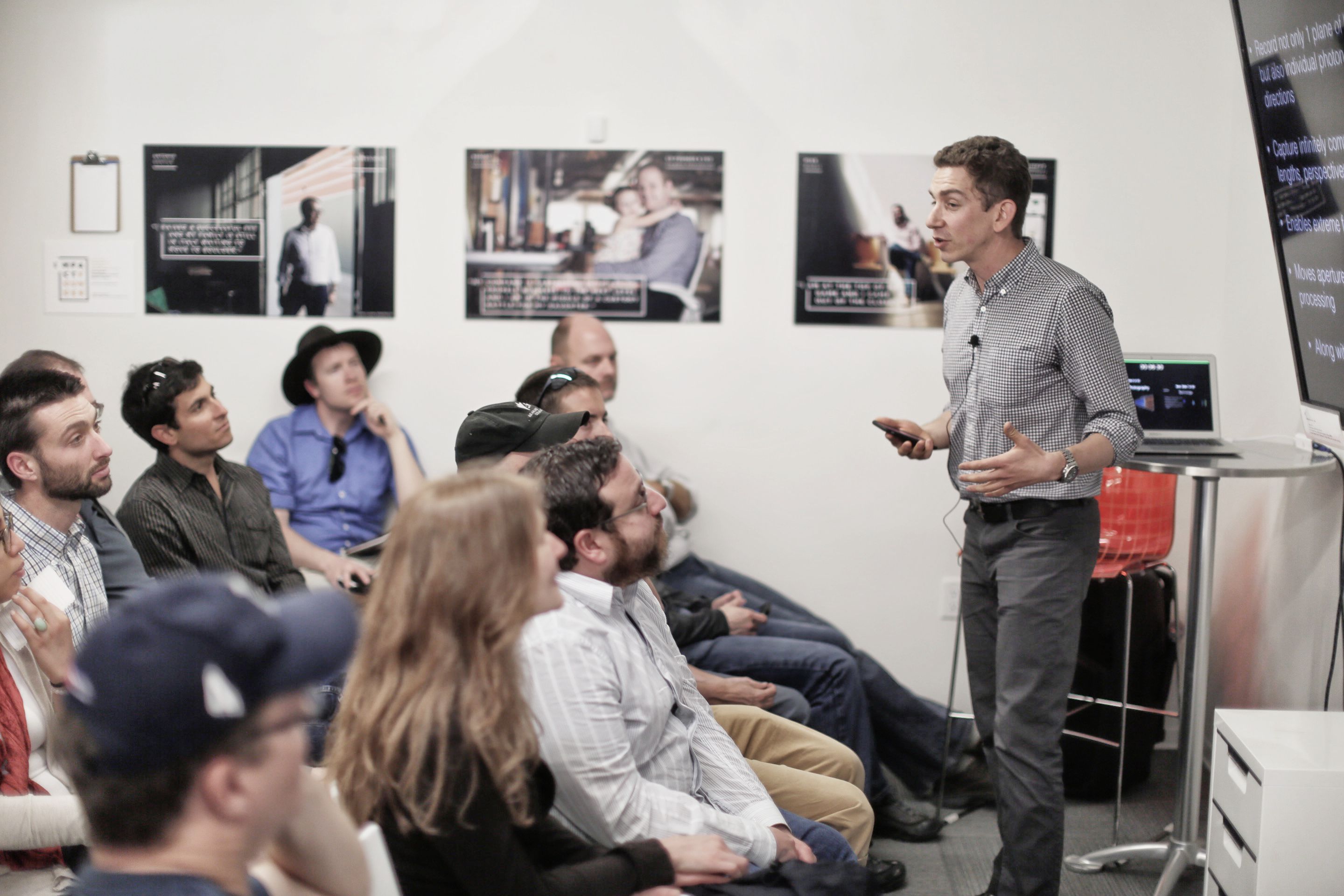
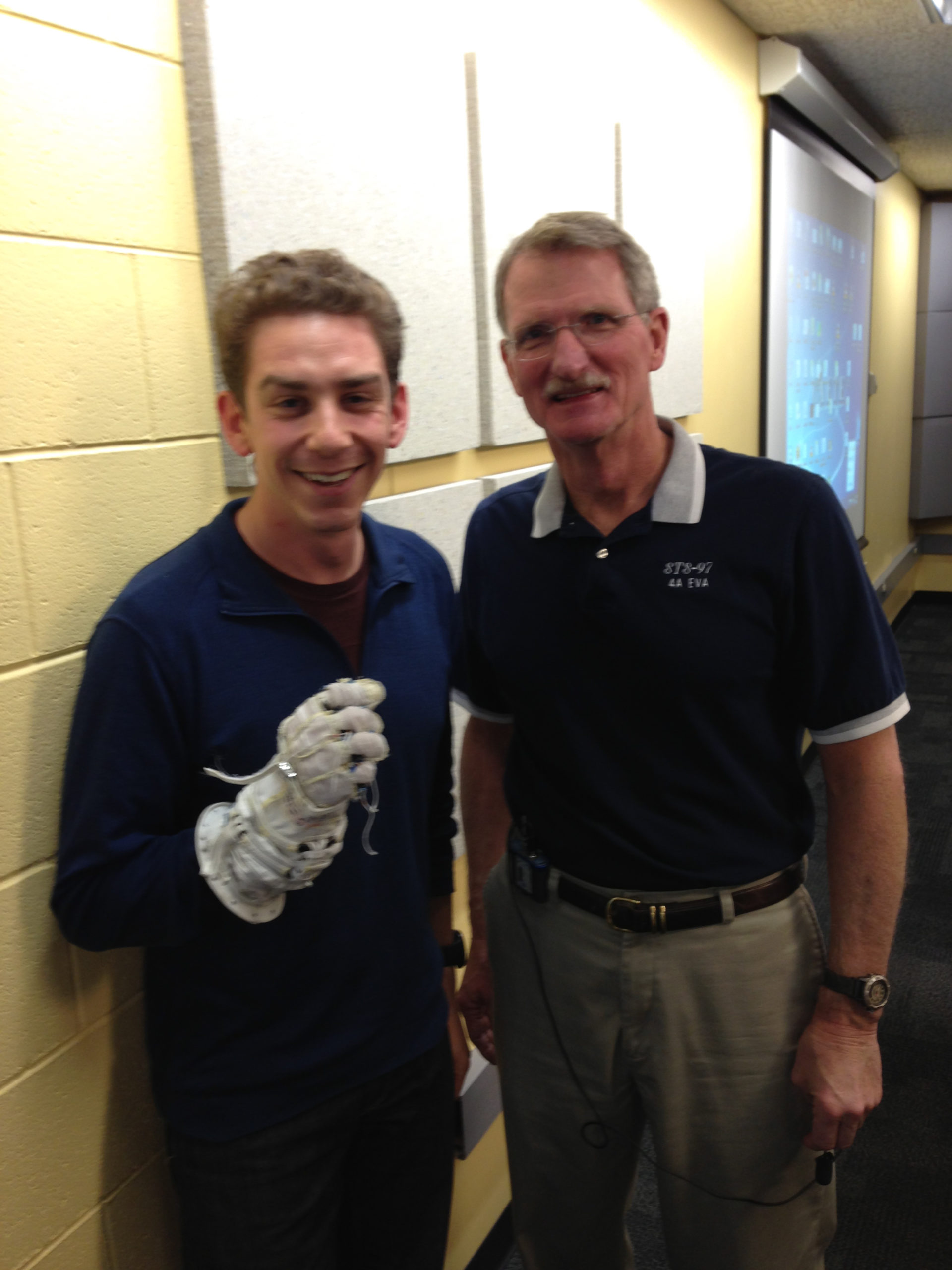
This past week, my brother Jason and I were fortunate enough to be allowed to sit in on a guest lecture at the University of Colorado Engineering Center by NASA Astronaut Joe Tanner. Joe spoke to us about the ins and outs of spacesuit design, and shared a bunch of his personal stories. A pic or two, as well as my brief notes:

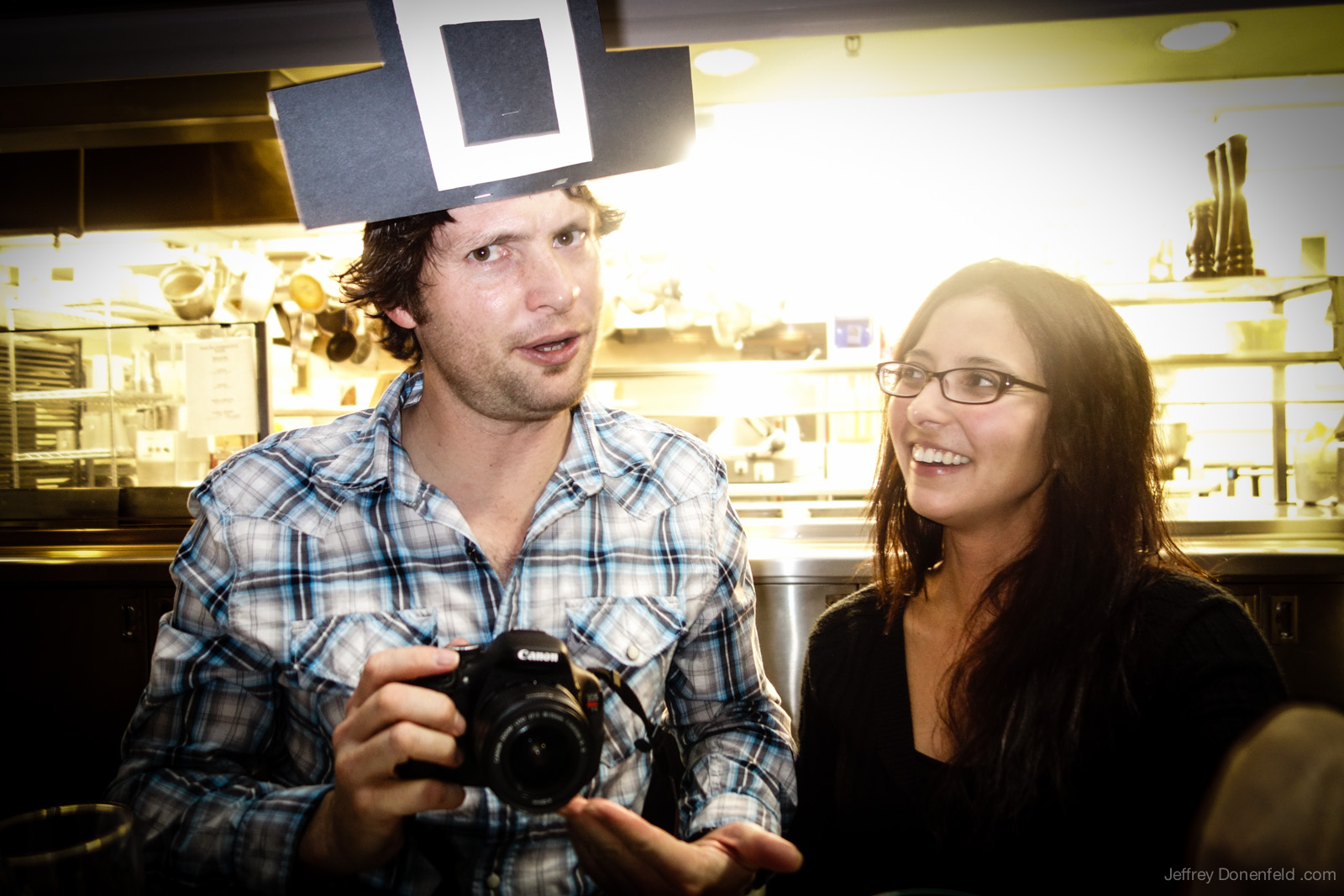
2012-10-30 Space and Guns - IMG_0429

Space Habitat Design  - ASEN 5158

Notes

  • Main challenges of EMU – refurbishment of the suit after every flight.
  • Now on ISS, suits left on station for a long time – like 6 months. modular components
  • EMU – on extended EVA’s, it’s necessary to resupply suit halfway through – takes 5 minutes minutes to refil o2.
  • Limiting consumable on EMU is the co2 scrubbing system
  • After Ed White’s gemini EVA, training focus was switched to underwater training
  • Apollo EVAs
    • Umbilical based
    • to pick up film from outside of module
    • no cooling system
    • Backpack – SOP – Secondary o2 pack
  • Apollo Lunar walk SOP
    • Very high center of gravity because of high location of SOP
  • STS
    • SAFER – cold gas jet mechanism for navigating in space.
  • Suited Environments
    • Launch, Entry and Abort – must be able to operate flight controls, as well as emergency depress/egress
    • Orbital – shirts and shorts, unless on TV, then nasa wants the astronauts to wear long pants.
    • Lunar/Mars – main concern is the dust – will eat the suit alive!
    • NEO’s – Biggest problem is body stabilization
  • Suit Functional Requirements
    • Environmental control and live support parameters
      • Maintain Pressure
      • Remove co2
      • Provide o2
      • thermal control
      • humidity control
      • trace contaminant control
      • mmod/radiation protection
      • food/water
        • water is space suit is tube with actual bite valve from Camelbak
      • waste
      • mobility/dexterity
  • ORLAN Russian Spacesuit
    • In use for 40+ years, still in use today. Pressurized at 5.7 psi suit, which makes an easier transition from cabin to eva, but makes hand dexterity more difficult.
  • Delta p Concerns
    • Getting from cabin pressure to suit pressure – issues include decompression sickness, bends, etc
    • Prevented by lowering cabin pressure, lowering N2 content in atmosphere, or lowering n2 content in human.
    • Prebreathe protocol – facilitate equilibrium
    • Zero prebreathe is at 8.3 psi
  • Haldane’s Ratio – Defines cabin/suit pressure ration based on risk of DCS
2012-10-30 Space and Guns - IMG_0430 Jeffrey Donenfeld and NASA Astronaut Joseph Tanner

Curiosity Rover Successfully Lands On Mars!!

Congratulations to the NASA/JPL-Caltech crew for successfully landing the Mars Science Laboratory’s Curiosity Rover on Mars! Here are the first images taken by Curiosity on the red planet..

This is the first image taken by NASA’s Curiosity rover, which landed on Mars the evening of Aug. 5 PDT (morning of Aug. 6 EDT). It was taken through a “fisheye” wide-angle lens on one of the rover’s front left Hazard-Avoidance cameras at one-quarter of full resolution. The clear dust cover on the camera is still on in this view, and dust can be seen around its edge, along with three cover fasteners. The rover’s shadow is visible in the foreground.
As planned, the rover’s early engineering images are lower resolution. Larger color images are expected later in the week when the rover’s mast, carrying high-resolution cameras, is deployed.
Credit: NASA/JPL-Caltech

NASA Administrator Charles Bolden’s statement:

NASA is back on Mars – and getting ready for the next mission to the Red Planet! After an astounding 154 million mile journey and a harrowing landing that demonstrated cutting-edge technology, Curiosity, the largest rover ever sent to another planet, is in place and ready to work. This robotic laboratory will seek answers to one of humanity’s oldest questions as it investigates whether conditions have favored development of microbial life on the Red Planet. The mission is a critical planetary science mission — and a precursor to sending humans to the Red Planet in the 2030’s, a goal set forth by President Obama.

It’s another great leadership moment for our nation and a sign of the continued strength of NASA’s many programs in science, aeronautics and human spaceflight. It’s also important to remember that the $2.5 billion investment made in this project was not spent on Mars, but right here on Earth, supporting more than 7,000 jobs in at least 31 states.

With the retirement of the Shuttle program after its final flight in July 2011, some have suggested that NASA’s leadership in the exploration of space, including our extraordinary successes on Mars, was coming to an end. Nothing could be further from the truth. The Curiosity mission is only the latest in a long list of extraordinary NASA missions that established the United States as the undisputed world leader, and it will help guarantee that remains the case for many years to come.

When our Orion deep space crew vehicle takes its first test flight in 2014, it will travel farther into space than any spacecraft designed for humans has flown in the 40 years since our astronauts returned from the moon.

In 2017, NASA’s Space Launch System (SLS), a heavy-lift rocket that will provide an entirely new capability for human exploration beyond low Earth orbit, will launch Orion.

We also reached a critically important milestone in May when SpaceX became the first private company to send a spacecraft — the Dragon cargo capsule — to the International Space Station and return it with cargo intact. This successful mission ushered in a new era in spaceflight — and signaled a new way of doing business for NASA. And just a few days ago, we announced the next step in the Obama Administration’s aggressive plan to once again launch our astronauts from U.S. soil on spacecraft built by American companies.

As part of our commitment to maintain American leadership in the exploration of Mars beyond the Curiosity mission, NASA will launch the Mars Atmosphere and Volatile EvolutioN (MAVEN) orbiter next year. Earlier this year, I directed NASA’s science mission director, along with the head of human exploration, Chief Technologist, and Chief Scientist to develop a more integrated strategy to ensure that the next steps for Mars exploration will support the nation’s planetary science objectives as well as our human exploration goals. They are looking at many options, including another robotic mission to land on Mars in this decade.

I am so proud of the NASA team that has made tonight’s challenging milestone possible. However, tomorrow we begin to plan for the next great challenge — and start compiling incredible scientific data from Curiosity. For the past 50 years, NASA has specialized in doing the hard things. Thanks to the ingenuity of our teams across America and the world, we are poised for even greater success.

For more information about Curiosity and NASA’s missions to Mars, visit:

http://www.nasa.gov/mars

The Mars Science Laboratory (MSL) team in the MSL Mission Support Area react after learning the the Curiosity rove has landed safely on Mars and images start coming in at the Jet Propulsion Laboratory on Mars, Sunday, Aug. 5, 2012 in Pasadena, Calif. The MSL Rover named Curiosity was designed to assess whether Mars ever had an environment able to support small life forms called microbes. Photo Credit: (NASA/Bill Ingalls)

President Obama’s Statement:

THE WHITE HOUSE
Office of the Press Secretary
FOR IMMEDIATE RELEASE
August 6, 2012

Statement by the President on Curiosity Landing on Mars

Tonight, on the planet Mars, the United States of America made history.

The successful landing of Curiosity – the most sophisticated roving laboratory ever to land on another planet – marks an unprecedented feat of technology that will stand as a point of national pride far into the future. It proves that even the longest of odds are no match for our unique blend of ingenuity and determination.

Tonight’s success, delivered by NASA, parallels our major steps forward towards a vision for a new partnership with American companies to send American astronauts into space on American spacecraft. That partnership will save taxpayer dollars while allowing NASA to do what it has always done best – push the very boundaries of human knowledge. And tonight’s success reminds us that our preeminence – not just in space, but here on Earth – depends on continuing to invest wisely in the innovation, technology, and basic research that has always made our economy the envy of the world.

I congratulate and thank all the men and women of NASA who made this remarkable accomplishment a reality – and I eagerly await what Curiosity has yet to discover.

###

Notes from LeWeb Conference, London

Today I virtually attended a couple of talks of the LeWeb conference in London. A few brief notes:

Jason Goldberg, Founder & CEO & Bradford Shane Shellhammer, Co-Founder & Chief Creative Officer, Fab & Michael Arrington, General Partner, CrunchFund

  • Best selling item on Fab.com? A vibrator. They’ve sold “tens of thousands” of them, especially the colorful ones. “Never thought we’d be an art or jewelry store”
  • What was the pivot you had to take from transitioning from a social network to your current state? It took a while to make the decision, but once we made the decision we turned off the website immediately. On day one of switching to commerce model, sold a ton.
  • Fab UK launching today, with help from Lustre team

Martin Varsavsky, Founder & CEO, Fon

  • “I don’t think that entrepreneurs need to work very hard. Here’s why.” How do I run Fon, and also take a 12 week vacation and work only in the morning? This is how:
    • Don’t watch television – only watch short things that keep your attention.
    • Into practicing sports, but not really into watching sports. If you’re not watching sports and you’re a guy, it’s like having your life free
    • Write a lot, don’t read a lot. Read just a little, and write more.
    • Fly your own plane and have a drive – save lots of time by having a driver. Elitist, but it helps maximize your time. Having a plane also helps even more. [ed - haha, douchebag.]
    • Almost never speak on the phone. Only talk on the phone to people you love, but rarely to get something out of somebody. Use apps and email to get stuff out of people. Phone sucks because it’s the last person you WANT to contact you is the first person who CAN contact you.
    • Don’t drink.
    • Don’t do business meals. Business meals are a waste of time and weird. It’s always awkward – business can be done in 10 minutes, not over a long awkward meeting.
    • Use social media.
    • GET ENOUGH SLEEP [ed - completely agree, sleep extremely important]
    • Go to conferences, but be selective about which ones you go to. Learn how to say no to certain things.
    • Take vacations, enjoy vacations.
    • Delegate intelligently - it’s the only way to buy your own time.

Sebastian Siemiatkowski, Co-Founder & CEO, Klarna & Tim Bradshaw, Digitial Media Correspondent, Financial Times

  • We got the idea of Klarna from a deep look at online payments, and a realization that the whole system has never been solved. Checkout processes online are a pain in the ass. How can we simplify it?
  • Old generation was empty wallet, Klarna is the full wallet.
  • Last year did 6 billion dollars of business, next year much more hopefully.
  • Klarna vertically integrates entire merchant and consumer experience. By doing this, they can control the entire process and give a much better experience in all stages. Klarna is not just a portal like other services.
  • Only need to use name and address to purchase, no further registration necessary. Key is to identify risk in an online environment, that Klarna can do a risk assessment by assessing consumer behavior on a website – they don’t have to look at traditional credit score data. Klarna says they can predict who will pay and who wont.
  • Backed by Sequoia Capital
  • Distinguished from other payment companies because Klarna collects SKU level data on every transaction, so they can give merchants and 3rd parties very very detailed consumer behavior data.
  • Can launch in any EU country because they can “passport” their license.

Biking the 110 Mile Gran Fondo NY

Last sunday was the Gran Fondo NY, a 110 mile bike ride through NJ and NY, done in the classic Italian Style. My friend Chris came up from DC for the ride, and we met up with a group of friends. I did the ride on my new Cannondale SuperSix bike, which I love. A bit on the Gran Fondo:

Gran Fondo New York brings Italian cycling culture to the world’s greatest city on May 19, 2013. Join thousands of cyclists on a challenging 110-mile Gran Fondo New York course from New York City to Bear Mountain and back in an experience fit for a pro and open to anyone who loves to ride.

The Couse:

Gran Fondo New York starts with a bang on the world’s most travelled bridge, George Washington Bridge, exclusively closed for you. Enjoy magnificent views of Manhattan during this once in a lifetime car free stint. Following Hudson upstream on rural roads and through scenic towns, riders will compete against each other and themselves on a timed climbs which will count towards the King and Queen of Mountain competition. The featured climb of the event and Cima Coppi (highest point of the ride) is the nearly four mile climb up to Bear Mountain in Harriman State Park. After descending, the course will wind its way back, hitting two more timed climbs before finishing in Weehawken with stunning NYC views.

The total ride distance is 110miles/177k and the elevation gain is 8,500ft/2,800m.

A few pics and videos from the ride:

Subway in the morning – packed with bikes.

IMG_0574

On the starting line

http://www.flickr.com/photos/jamfan2/7246255960/in/set-72157629840604330

Rolling north

IMG_3885

Top of Bear Mountain!

IMG_0585

Finished!

IMG_3916